
史瓦西度規
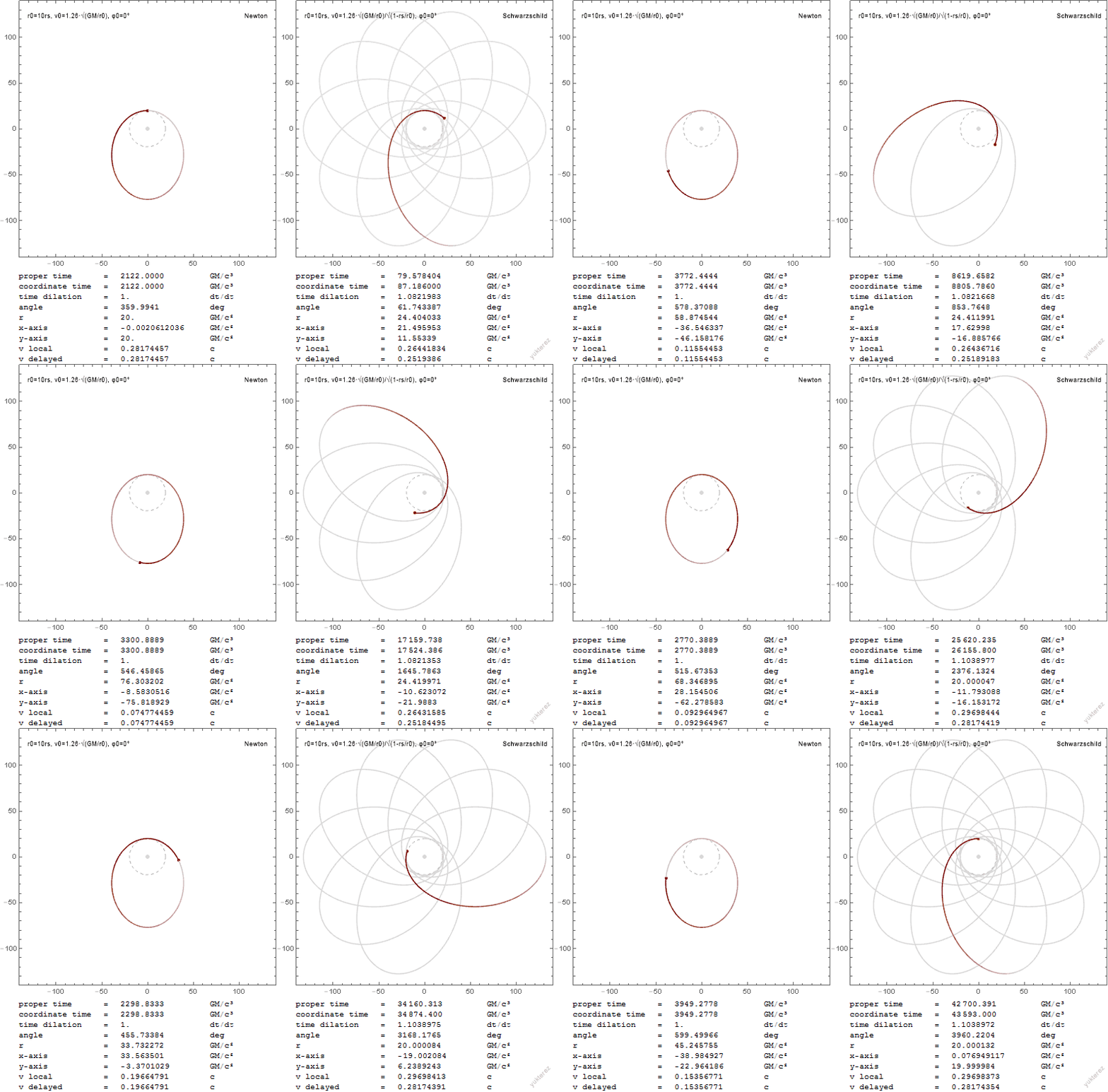
施瓦齐尔德度量是由卡尔-施瓦齐尔德在1916年计算出的爱因斯坦场方程的解。它也被称为施瓦锡尔德解,是天体物理学领域广义相对论中的一个方程。公元指的是描述时空的方程,特别是,施瓦兹基德公元描述的是施瓦兹基德黑洞--一个不旋转、没有磁场的球形黑洞,宇宙学常数为零--周围的引力场。 它本质上是一个描述粒子如何在黑洞附近的空间中移动的方程。 ( d s ) 2 = - c 2 ( 1 - 2 G M r c 2 ) ( d t ) 2 + 1 ( 1 - 2 G M r c 2 ) ( d r…
施瓦齐尔德度量是由卡尔-施瓦齐尔德在1916年计算出的爱因斯坦场方程的解。它也被称为施瓦锡尔德解,是天体物理学领域广义相对论中的一个方程。公元指的是描述时空的方程,特别是,施瓦兹基德公元描述的是施瓦兹基德黑洞--一个不旋转、没有磁场的球形黑洞,宇宙学常数为零--周围的引力场。
它本质上是一个描述粒子如何在黑洞附近的空间中移动的方程。
( d s ) 2 = - c 2 ( 1 - 2 G M r c 2 ) ( d t ) 2 + 1 ( 1 - 2 G M r c 2 ) ( d r ) 2 + r 2 ( d θ ) 2 + r 2 sin 2 ( θ ) ( d ϕ ) 2 {\displaystyle (ds)^{2}=- 。c^{2}(1-{/frac {2GM}{rc^{2}})(dt)^{2}+{/frac {1}{(1-{/frac {2GM}{rc^{2}})}}(dr)^{2}+r^{2}(d/theta )^{2}+r^{2}/sin ^{2}(theta )(d/phi )^{2}}}。 
图片库
2 图片
衍生
虽然一个更复杂的方式计算Schwarzschild度量可以找到使用Christoffel符号,它也可以导出使用方程逃逸速度(v e {/displaystyle v_{e}} ),时间扩张(dt'),长度收缩(dr')。
v e = v = 2 G M r {\displaystyle v_{e}=v={\sqrt {\frac {2GM}{r}}}}。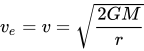 (1)
(1)
v是粒子的速度
G是引力常数
M是黑洞的质量
r是粒子与重物的
距离有多近。
d t ′ = d t 1 - v 2 c 2 {/displaystyle dt'=dt{/sqrt {1-{/frac {v^{2}}{c^{2}}}}}}。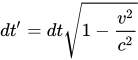 (2)
(2)
d r ′ = d r 1 - v 2 c 2 {/displaystyle dr'={/frac {dr}{/sqrt {1-{/frac {v^{2}}}{c^{2}}}}}}}。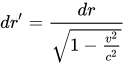 (3)
(3)
dt'为粒子在时间上的真实变化
dt为粒子在时间上的变化dr
'为
粒子的真实移动距离
dr为粒子的距离变化
v为粒子的速度
c为光速。
注意:粒子所走的真实时间间隔和真实距离与经典物理学计算的时间和距离不同,因为它是在如此重的引力场中行进的!
利用球面坐标中的平面时空方程。
( d s ) 2 = - c 2 ( d t ) 2 + ( d r ) 2 + r 2 ( d θ ) 2 + r 2 sin 2 ( θ ) ( d ϕ ) 2 {\displaystyle (ds)^{2}=-c^{2}(dt)^{2}+(dr)^{2}+r^{2}(d\theta )^{2}+r^{2}\sin ^{2}(\theta )(dphi )^{2}}}。 (4)
(4)
ds是粒子的路径
θ {\displaystyle \theta} 是角度。
是角度。
dθ {\displaystyle \theta }和dϕ {\displaystyle \phi } 是角度的变化。
将逃逸速度、时间膨胀和长度收缩的方程(方程1、2、3)输入平坦时空的方程(方程4),得到施瓦兹基德度量。
( d s ) 2 = - c 2 ( 1 - 2 G M r c 2 ) ( d t ) 2 + ( d r ) 2 ( 1 - 2 G M r c 2 ) + r 2 ( d θ ) 2 + r 2 sin 2 ( θ ) ( d ϕ ) 2 {\displaystyle (ds)^{2}=- 。c^{2}(1-{/frac {2GM}{rc^{2}})(dt)^{2}+{/frac {(dr)^{2}}{(1-{/frac {2GM}{rc^{2}}})}+r^{2}(d/theta )^{2}+r^{2}\sin ^{2}(\theta )(d/phi )^{2}}}。 (5)
(5)
From this equation we can take out the Schwarzschild radius ( r s {\displaystyle r_{s} } ), the radius of this black hole.从这个方程我们可以拿出Schwarzschild半径( r s {\displaystyle r_{s}} ),这个黑洞的半径。Although this is most commonly used to describe a Schwarzschild black hole, the Schwarzschild radius can be calculated for any heavy object.
( d s ) 2 = - c 2 ( 1 - r s r ) ( d t ) 2 + 1 ( 1 - r s r ) ( d r ) 2 + r 2 ( d θ ) 2 + r 2 sin 2 ( θ ) ( d ϕ ) 2 {/displaystyle (ds)^{2}=- 。c^{2}(1-{/frac {r_{s}}{r}})(dt)^{2}+{/frac {1}{(1-{/frac {r_{s}}{r}})}(dr)^{2}+r^{2}(d\theta )^{2}+r^{2}\sin ^{2}(\theta )(d\phi )^{2}}}。 (6)
(6)
r s {displaystyle r_{s}}是设定的对象半径限制。
问题与解答
问:什么是施瓦兹柴尔德公转?
答:施瓦兹柴尔德公转是天体物理学领域广义相对论的一个方程,描述了粒子如何在黑洞附近的空间中运动。它是由卡尔-施瓦茨柴尔德在1916年计算出来的,作为爱因斯坦场方程的一个解决方案。
问:公制指的是什么?
答:公转指的是描述时空的方程;特别是,施瓦兹柴尔德公转描述了施瓦兹柴尔德黑洞周围的引力场。
问:施瓦茨柴尔德黑洞有哪些特征?
答:施瓦兹柴尔德黑洞是不旋转的,是球形的,没有磁场。此外,它的宇宙学常数为零。
问:我们如何描述施瓦兹柴尔德黑洞周围的引力场?
答:我们可以用施瓦兹柴尔德公转方程来描述它,该方程描述了粒子如何在这种类型的黑洞附近的空间运动。
问:谁首先计算了这个方程?
答:卡尔-施瓦茨柴尔德在1916年首次计算了这个方程,作为爱因斯坦场方程的一个解决方案。
问:在这个方程中,(ds)^2代表什么?
答:(ds)^2表示相对于时间和空间坐标而言,时空上两点之间的距离。
相关文章
作者
AlegsaOnline.com 史瓦西度規 Leandro Alegsa
URL: https://zh.alegsaonline.com/art/88002
来源
- arxiv.org : arxiv.org/pdf/physics/9912033.pdf
- sites.math.washington.edu : sites.math.washington.edu/~morrow/336_19/papers17/carson.pdf
- arxiv.org : arxiv.org